The Smart Centre premise at Lobule Refugee Settlement
The Smart Centre is a ForAfrika initiative designed to boost food security and improve livelihoods in Koboko District and West Nile region, a vital area for both refugees and host communities.
The technology transfer centre located at Lobule refugee settlement adjacent to Atur River, spans over six acres and offers a wide range of services and facilities aimed at sustainable growth and transformation.
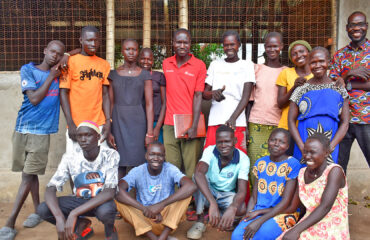
The Smart Centre provides services to 10 farmer groups including refugees and host communities comprising 300 farmers—92 men and 208 women. The objective is to bring these farmer field school members together to operate at a cooperative level.
The Centre aims to facilitate job creation for women and youth, both in the refugee and for the host communities—the Centre’s target beneficiaries. “We offer a pathway to economic self-reliance through financial modeling, training in modern agricultural technologies and together with special livelihood partners, we share ideas on how to best support this community so that they can move from survival to thriving,” states Smart Centre training and extension officer, Nehemiah Lwate.
The Smart Centre is critical for building up and improving farming skills in Koboko District. “Here, people go all the way to Arua for training. We take pride in having our own centre where our people will go to acquire skills. I am optimistic that once fully established and commissioned with all the necessary facilities, it will be the best in the Western Nile region,” chairperson of Koboko District Local Council V, Mambu Asirafu, states.
Weather-resilient agriculture
Most of the farmer group members have adopted most of the practices as seen in their gardens. ForAfrika supplies farmers with weather-resilient seeds to plant at their individual household plots that measure 30 by 30 feet. The seeds suit the local agroecological conditions, and the crops are high-value market crops that attract a ready market. They are also given tools, pesticides, and fungicides.
The seeds can tolerate drought and dry spells and are resistant to some pests and diseases. The farmers are also advised to practice agroforestry, which has boosted the number of trees in the area. These trees are critical in sequestering carbon into the soil.
One of the model farmers the Centre has produced is Tumalu Saidia. “The training enabled me to understand the importance of planting crops in a line. I now know that it makes weeding easy. Also, we are now knowledgeable in the control of pests and the importance of timing watering of crops. I am able to raise seed beds,” she says.

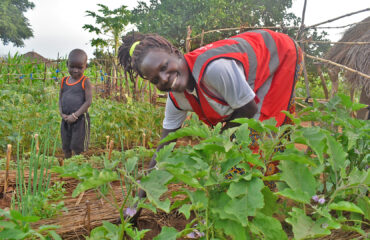
Saidia’s plot is teeming with tomatoes, thanks to the skills she acquired at the Smart Centre. A citizen of the Democratic Republic of Congo (DRC), she came to Uganda in 2013 to escape war in her country. She has three teenage children and is a single parent. She explains that “during the training, we were educated that crops of the same families should not be grown in succession. Last year, I planted cabbage. And this year I decided to plant tomatoes because they belong to a different family.”
By applying crop rotation, Saidia had a good tomato harvest. She earned UGX700,000 (USD 197) which she used to pay school fees, buy certified seeds, and provide water for her gardens. Since the 30 by 30 feet plot given to the refugees was not enough to meet her needs, Saidia leased a quarter of an acre from a local resident at UGX80,000 (USD 22) to plant tomatoes.
Another refugee from the DRC, Moses Ngule, a father of 12 and husband to two wives, hopes to return to his country when peace prevails. The 57-year-old received training from the Centre three years ago. He has immersed himself in farming, employing skills that were inculcated in him at the Smart Centre.
“Before the training, we used to grow vegetables. But we did not have the knowledge on how to identify the best seeds, planting and weeding techniques and pests control. We realised dismal harvests,” Ngule says. He has since the training applied the traditional way of keeping pests at bay. He recently mixed lemon leaves, chilli, and detergents and applied the mixture to his crops to good effect.

In 2024, Ngule sold cabbages and tomatoes and earned UGX800,000 (USD 224). In 2025, the tomato crop failed to thrive. He only netted UGX100,000 (USD 28) from sales. But he received an impressive UGX500,000 (USD 140) from cabbage sales. He has leased a quarter of an acre on which he grows vegetables. He spends his income on food, healthcare, and buying vegetable seeds. His ambition is to make enough money from farming and open a business, in addition to expanding his farming activities.
Village savings and loans associations
Some households could not afford certain household assets before ForAfrika’s support. To address this, the Smart Centre initiated village saving and loans associations (VSLAs). “We encourage the farmers to join VSLAs through which we train them on the importance of saving to be able to achieve their goals. One woman had a goal of buying a cow during a saving cycle. She successfully bought the cow,” states Lwate. In addition to achieving her goal, she was also able to pay fees for her children.
Aggregation centre
The Centre embraces a market-led aggregation model by bringing the farmers together as a cooperative society and they aggregate their produce at the Centre’s bulking store to sell when the prices are favourable . For high value chain perishable crops such as cabbages and tomatoes, plans are underway to set up a cold room for storage to extend shelf life.
Knowledge transfer is an ongoing process at the Centre. The target farmers can learn practical skills from the demonstration farm at the Centre. The Centre’s 5.3- acre demonstration farm is currently flourishing with cabbages, cassava, beans, groundnuts, tomatoes, onions, kale and eggplant. The progress realised on Moses Ngule’s and Tumalu Saidia’s gardens is a clear testimony that the Smart Centre is on course to achieve its objective.