Catalytic transformation for Africa to thrive
Our vision is for Africa to thrive
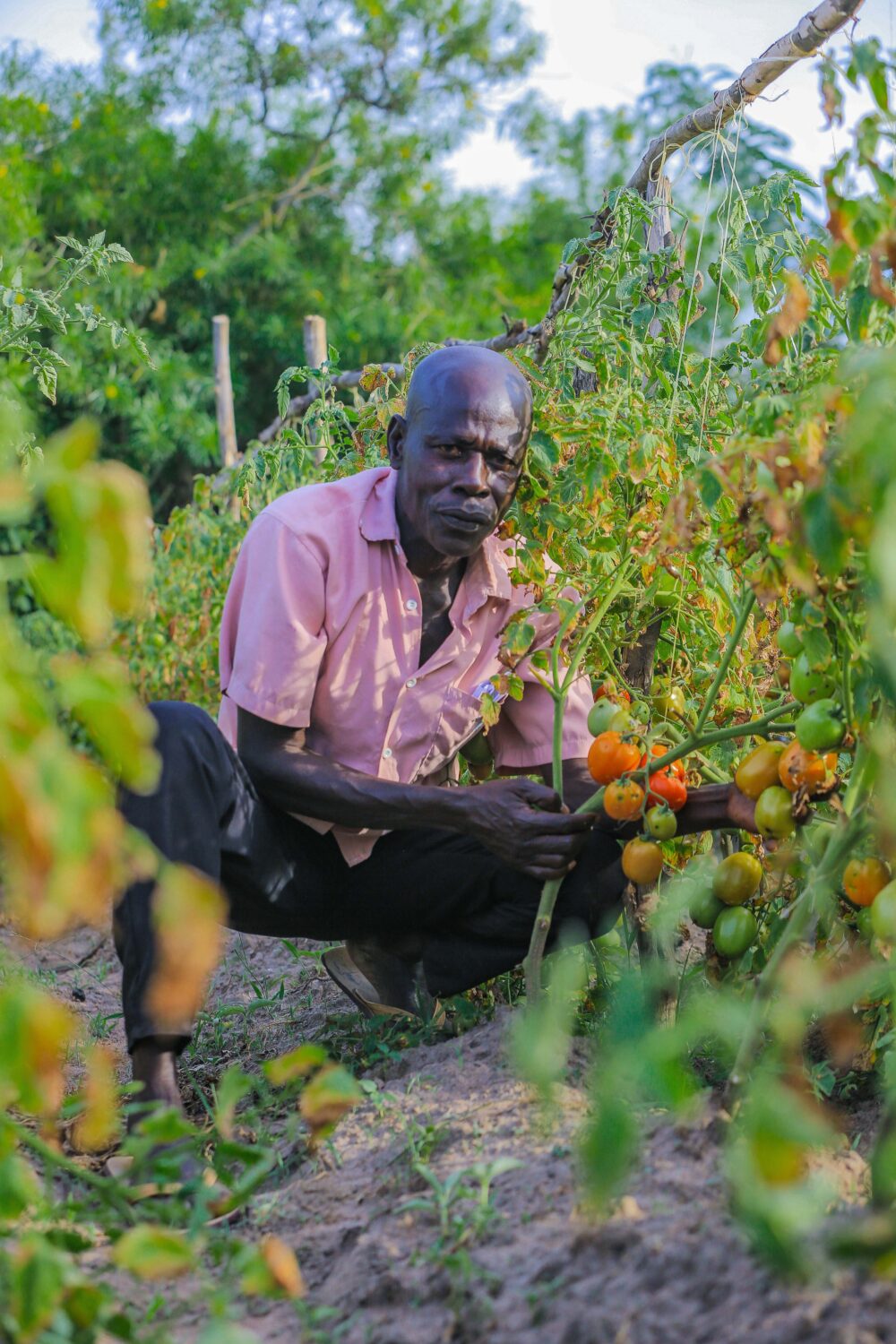
Over time, Odrijia lost interest in tobacco growing, which he described as labour-intensive and expensive. He had been gravitating towards alternative crops such as rice and horticulture. In 2021, he fully embraced horticulture.
Farmers in Kubala area in Terego District in the West Nile region of Uganda had, for a long time, been confined to tobacco and simsim growing. The labour-intensive tobacco farming was the main source of income and many farmers noted that the rewards were not commensurate with the investments made, particularly given the crop’s associated health hazards.
Odrijia currently grows watermelon, cabbage, tomato and maize. In 2025, he planted one acre of tomatoes, 0.75 acres of cabbage and half an acre of watermelons. Odrijia’s transition to horticulture reflects a shift among farmers in Terego District who are embracing high value crops. This change is reinforced by organisations that are providing inputs, training and market linkages to boost smallholder farmers’ incomes and food security. These organisations also offer modern agricultural practices through agribusiness support for better yields and improved post-harvest handling, especially for crops like tomatoes.
Odrijia is a member of the Kubala Horticultural Farmers Group which is supported by ForAfrika’s Agriculture Market Support Project (AMS). The objective of AMS is to sustain existing jobs, enhance livelihoods, create new jobs and build the resilience of smallholder farmers among the refugees and nationals with a key focus on women and youth in the targeted districts. The project aimed to create 11,545 jobs by the end of 2025.
Kubala Horticultural Farmers Group has 30 members out of which 21 are women while nine are men. ForAfrika has built the capacity of group’s members in financial literacy, group governance, good agronomic practices, bulking and sales, marketing of produce, farming as a business and post-harvest management.
ForAfrika’s community-based facilitator attached to the farmer’s group, Francis Enzama, says his organisation has encouraged the farmers to diversify into horticulture instead of undertaking tobacco farming only. “In addition to training, ForAfrika provided the farmers with tomato seeds, chemical fertiliser, solar power for the irrigation system and a tricycle to help transport produce to the markets,” states Enzama. The farmer group’s biggest markets are Imvepi Refugee and Rhino Camp Refugee settlements.
“ForAfrika has equipped us through training in good agronomic practices. The knowledge we have acquired has made us better farmers. As a result, our farm productivity has increased,” Nyakun James, the chairperson of the group, says. Before the ForAfrika project, farmers would undertake farming without the support of extension officers. The lack of knowledge in agribusiness led to poor yields and losses.
“Before the training, we harvested very little. I could get UGX1,000 (USD 0.28) from a single tomato plant. Currently, I can get five times that amount,” states Odrijia. “The training has had an impact. We are now knowledgeable in disease identification, harvest and post-harvest management including tomato preservation and marketing,” Odrijia adds. Through ForAfrika training, farmers, with the support of extension staff, are able to effectively manage diseases and have been trained in how to use chemicals effectively.
Last season, Odrijia grew watermelons on half an acre and had a bumper harvest. He earned UGX2 million (USD 560) from sales. “I used the money to address my family needs including school fees and saving. I used part of the money to lease land on which I plan to plant watermelon, sorghum, maize and cassava,” Odrijia adds. He grows watermelons during the dry season, when the hot weather produces sweeter, higher‑quality fruit.
It is difficult to persuade Odrijia to return to tobacco farming. “When I was a tobacco farmer, I received money only once a year and it was modest. But now, as a horticulture farmer, I receive money regularly once I sell my produce, which enables me to meet my financial obligations,” he asserts.
Currently, the group has a one and half acre demonstration farm with watermelon crop. What they learn at the demonstration farm has been replicated on individual farms, with the group keen on monitoring the progress of each individual farmer.
Nyakun is confident that the crop the group is currently tending will yield a bumper harvest. “We have been meticulous in the application of good agronomical practices. I am confident that we will harvest around 800 heads of watermelon from one acre,” he states. The crop is almost mature. The farmers typically sell the biggest watermelons from UGX10,000 (USD 2.80) to UGX12,000 (USD 3.37) per head.
The group’s February 2025 tomato harvest was its most successful yet, thanks to the adoption of good agronomic practices, generating a remarkable UGX 80 million (USD 22,438) in sales. Thirty percent of this income was loaned to eight farmers to help them meet various family financial needs.
Change in fortunes at the group level is also reflected at household level where incomes have improved because of adopting modern farming practices. “Most of us are now able to build permanent houses and pay school fees for our children,” states Nyakun.
For Odrijia, his vision is to expand his horticultural farming activities. He has already leased land for the expansion after realising that his two-acre farm is not enough. “I plan to increase my production of cabbage, watermelon and tomatoes because of an assured market. ForAfrika has linked us to the markets. Transporting produce to the market is no longer a challenge because we have a tricycle,” he states. Equipped with the knowledge on good agronomical practices, Odrijia can only hope for improved yields and increased profitability.
 Read more +02 October 2026 By ForAfrika in Uganda
 Read more +02 October 2026 By ForAfrika in Rwanda
 Read more +29 September 2026 By ForAfrika in Central African Republic, Food Security and Livelihoods
| Cookie | Duration | Description |
|---|---|---|
| cookielawinfo-checkbox-analytics | 11 months | This cookie is set by GDPR Cookie Consent plugin. The cookie is used to store the user consent for the cookies in the category "Analytics". |
| cookielawinfo-checkbox-functional | 11 months | The cookie is set by GDPR cookie consent to record the user consent for the cookies in the category "Functional". |
| cookielawinfo-checkbox-necessary | 11 months | This cookie is set by GDPR Cookie Consent plugin. The cookies is used to store the user consent for the cookies in the category "Necessary". |
| cookielawinfo-checkbox-others | 11 months | This cookie is set by GDPR Cookie Consent plugin. The cookie is used to store the user consent for the cookies in the category "Other. |
| cookielawinfo-checkbox-performance | 11 months | This cookie is set by GDPR Cookie Consent plugin. The cookie is used to store the user consent for the cookies in the category "Performance". |
| viewed_cookie_policy | 11 months | The cookie is set by the GDPR Cookie Consent plugin and is used to store whether or not user has consented to the use of cookies. It does not store any personal data. |